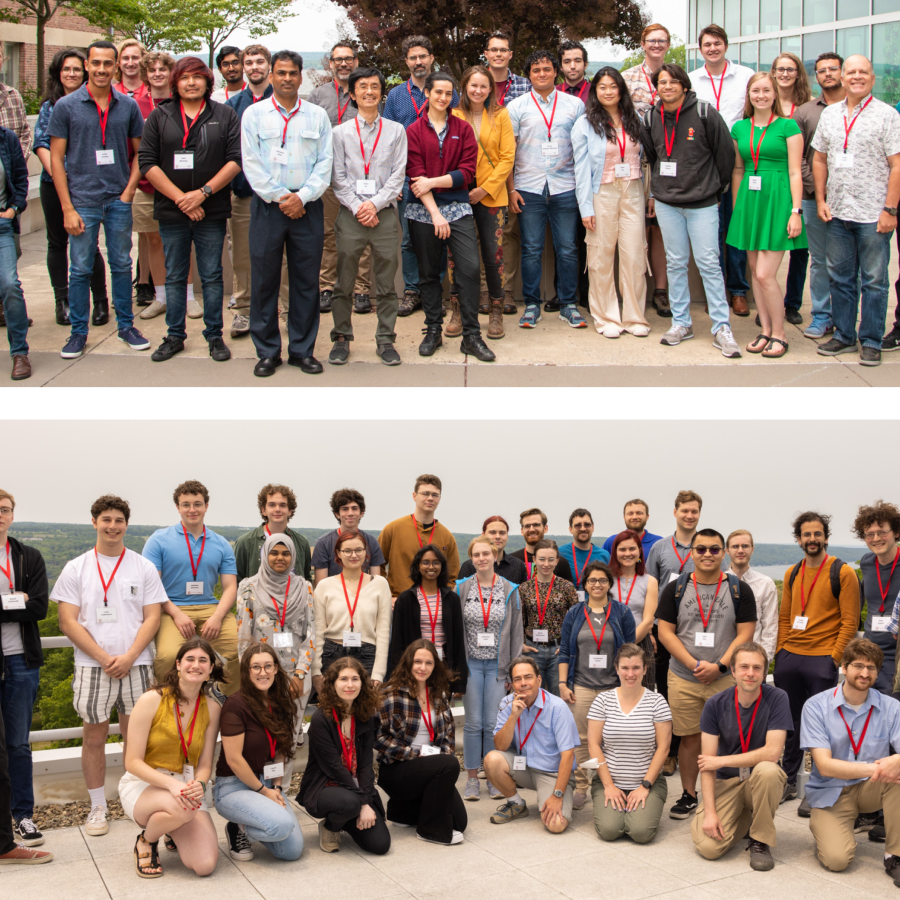
Students of Community College in New York State interested in a career in science, engineering, and technology have the opportunity to participate in research and development projects at CHESS!
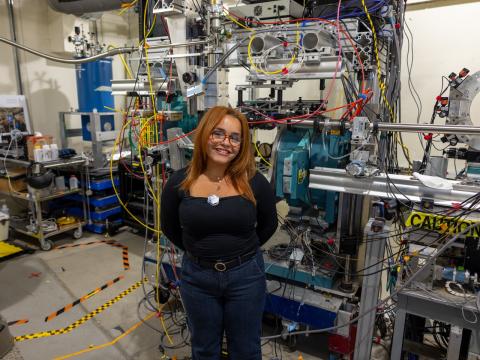
The 2026 program runs June 1 - August 7. Participants will receive a stipend. Local group housing will be provided through Cornell University Campus life for participants who prefer not to commute daily.
In the summer of 2026, we will be performing research on campus, along with formal lectures, tours of research facilities, social and recreational events, and a forum at the program's end in which participants present results of their research. Applications for the 2026 summer program must be submitted, via the link above, by April 15 2026.
| MENTOR | STUDENT | 2026 PROJECT | ABSTRACT |
|---|---|---|---|
| Estella Yee, CHESS Staff Scientist | TBD | Co-flow cell development for bioSAXS | Solution-state biological small-angle X-ray scattering typically relies on flow cells for efficient sample loading and precise background matching. Biological molecules, however, are easily damaged by synchrotron X-rays and can accumulate inside flow cells over the course of an experiment, increasing background and noise. An inner laminar sheath flow, known as a coflow, has been demonstrated at other facilities to ameliorate this issue by preventing damaged samples from contacting the flow-cell surfaces. A coflow setup thus allows high-intensity X-rays to irradiate the sample without the consequences of increased background, significantly improving data quality. A summer student will assist with the development and setup of a coflow sample cell for routine use at beamline 7A, along with any necessary control software and hardware. |
| Kate Shanks, CHESS Staff Scientist | TBD | An interactive web-based tool for experiment planning at FAST | The Forming and Shaping Technology (FAST) beamline at CHESS focuses on in-situ high-energy diffraction and imaging measurements of structural materials under various thermomechanical loading and processing conditions. Optimizing the experimental setup, in particular choice of energy, area detector, and sample-to-detector distance, involves a number of trade-offs regarding real- and/or reciprocal-space coverage, detector angular resolution, temporal resolution, and signal strength. These tradeoffs can be particularly challenging to visualize for diffraction measurements. This project will focus on the development of a web-based visualization tool, building off existing Python codes, for the planning of diffraction experiments to assist FAST users in evaluating the trade-offs involved in various choices of experimental setup parameters. |
| Kate Shanks, CHESS Staff Scientist | TBD | Beamline integration of a novel area detector for high-rate diffraction experiments | The mechanical properties and response to loading in many materials are known to depend on the applied strain rate ñ a sudden impact can produce markedly different behavior than gradual loading. As such, there is a pressing need for experiments probing the micromechanical response of materials subjected to high strain rates. The Keck-PAD is a novel x-ray area detector developed at Cornell to enable diffraction experiments at kHz ñ MHz frame rates, allowing studies of high-rate phenomena such as dynamic compression, high-speed machining, and ballistic impact. A medium-format prototype for dedicated use at CHESS as been assembled, and now requires integration with existing beamline instrumentation. In this project, the student will assist with integration at the FAST/ID3A beamline, with a focus streamlined detector control and user-friendly data visualization. |
| Kate Shanks, CHESS Staff Scientist, and Rolf Verberg, Programmer/Analyst for MSN-C | TBD | Development of a data processing workflow for synchrotron tomography on extended objects | X-ray computed tomography (CT) is a powerful tool for probing the internal structure of extended objects at the micron length scale. Whereas medical doctors use x-ray CT as a diagnostic tool to identify features inside the human body, researchers at synchrotron light sources use this technique to study the internal features of a wide variety of materials including rocks, metals, fossils, and so on. In a tomography measurement, the sample is rotated in the x-ray beam and an absorption- or phase-contrast image is collected on an area detector at each point during the rotation series. The detector images can then be processed, using established algorithms, to yield a reconstructed representation of the 3D volume. As part of the CHESS Analysis Pipeline (CHAP), CHESS has developed a standardized user-facing data processing workflow for tomography on samples with maximum width smaller than the horizontal x-ray beam size (typically ~2-3 mm), but does not yet offer the same in-house data processing capabilities for tomography data collected on larger samples. Data collection for samples larger than the x-ray beam typically involves scanning the sample through the x-ray beam in both the vertical and horizontal directions and taking rotation series data at each point. In this project, the student will extend existing CHAP tomography data processing codes to accommodate this extended-object scan strategy. Previous experience with Python programming is an asset. |
| John Indergaard, MacCHESS Engineer | TBD | Omnimounter: a sample handling robot for non-frozen protein crystals | CHESS beamline 7B2 specializes in protein structure determination using X-ray crystallography. Conventional diffraction experiments are typically performed at cryogenic temperatures, where robotic systems using liquid nitrogen and cryogenic gas streams enable highly efficient, remote data collection. Increasingly, however, cutting edge studies require measurements on samples under controlled temperature and pressure to better understand biomolecular function under physiologically relevant conditions and in organisms adapted to extreme environments. For these experiments, sample handling remains labor-intensive and a limits broader adoption. Last summer we initiated the design and fabrication of the “Omnimounter”, a robotic system for automated handling of room temperature protein crystals, with the goal of enabling a high-throughput mail-in program for non-frozen samples. This summer, a small team at CHESS will continue development of this system, expanding it to include precise humidity and temperature control during sample handling and measurement. The SERCCS student will contribute to aspect of design, fabrication, assembly, programming, and testing of the robotic platform, as well as experiments to establish methods for maintaining humid conditions around the samples. The specific focus of the project will be flexible and tailored to the student’s interests and skills, allowing emphasis on different components such as CAD design, electronics, software development, or experimental methodology. Applicants should have a strong interest in developing hands-on laboratory skills and in designing and experiments; experience with mechanical CAD design software (e.g. Autodesk Inventor), electronic circuits, and programming (e.g. Python) is beneficial, but not required. |
Previous years' projects can be found here: