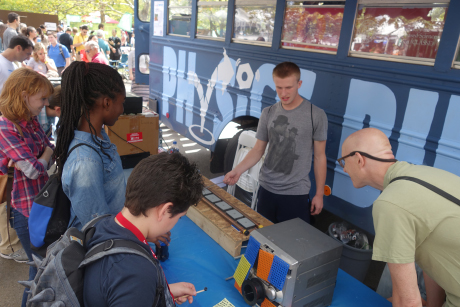
Ithaca Physics Bus and local teens take physics to NYC
On its maiden voyage out of Ithaca, the Ithaca Physics Bus, whose mission is to bring science to the public, brought some 20 exhibits that students in the JunkGenies Greater Ithaca
But despite this importance, existing methods to probe such events, involving strain rates of 103-105 s-1, provide only limited or indirect information about the atomic-scale rearrangement that materials undergo.
For example, the skins of many plants and animals have intricate microscale features that give rise to useful properties such as repelling water, adhesion, color-adaptation, camouflage, and resistance to wear or degradation. Try as we have, it is still very difficult or impossible to achieve efficient top–down fabrication processes.
Summer undergraduate research students at CLASSE have been actively influencing the sphere of science education across campus and the community. During their brief time at CLASSE, these students are shaping the research that occurs in laboratory spaces, showcasing their efforts and understanding in conference rooms, and driving the conversations and questions that occur in communal areas. In the laboratory, student devote hours of their time combing through the literature, contributing to the investigation, collecting data, and compiling their results.
What did the Scientists Discover?
Materials were as varied as conjugated small molecules [5,10,18], pharmaceutical molecules [16], metal-organic frameworks [19], cellulose nanocrystals [7], and hybrid organic-inorganic perovskites [2,3,8,9,13] (all in GIWAXS mode) as well as monodisperse nanoparticles [1,14,17], and block copolymers, polymer membranes, and polymer brushes [4,6,11,12,15] in GISAXS mode. In GIWAXS mode length scales probed are 1-3 nm, in the GISAXS modes 2-20 nm for nanoparticles and 20-80 nm for block copolymers.
Solution small-angle x-ray and neutron scattering methods are having an increasing impact in structural biology largely due to advanced hardware, data analysis and modeling. The objective of this course is to give users hands-on practical experience with a variety of software tools that provide powerful capabilities for processing, analyzing and modeling BioSAS experimental data.
CHESS is a high-intensity X-ray source, primarily supported by the National Science Foundation, that provides users with state-of-the-art synchrotron radiation facilities for research in physics, chemistry, biology and environmental and materials sciences.
Encompassing both didactic lectures and tutorials as well as “hands-on” experiment time at C-line, the workshop focused on giving participants a thorough background in both the practical and theoretical aspects of x-ray emission spectroscopy (XES) and high energy resolution fluorescence detected x-ray absorption spectroscopy (HERFD XAS).